


Super User
SHAN JIN

VOID
There is a Chinese saying: Great music has the faintest notes; great form is beyond shape.
In this project, the aesthetic value of gemstones is transformed into charming and beautiful works in this way. The set of works uses a framework to depict gemstones and their refracted light, attempting to evoke a delicate and ethereal beauty about space. The void outlined by the metal line implies the space occupied by gemstones, which can accommodate infinite possibilities and is not bound by internal concepts, reflecting the profound thinking of empty spaces in Chinese culture.
Materials: Brass gold plated, 3D printing.


NOVA SMITH

MIR Space Station
MIR is a sculptural object with modular, removable sections that can be worn on the body.
These modules are wearable containers designed to house precious items during everyday life and space travel.
This piece was speculatively designed for Helen Sharman; the first British astronaut who also visited the MIR Space Station.
MATERIALS: Brass, Steel, Copper, Sterling silver, Parian ceramic


Roma Jewellery Week 2023

Alternatives gallery, in collaborazione con AGC Associazione Gioiello Contemporaneo, presenta i lavori di 18 designer internazionali, frutto delle loro ultime ricerche artistiche nell’ambito dell’ornamento personale.
La mostra è ospitata dal 07.10.2023 al 14.10.2023, presso la sede della galleria Alternatives a Roma in via della Chiesa Nuova 10, con inaugurazione il giorno 07.10.2023 alle ore 16.30, ed è parte integrante del progetto più ampio di valorizzazione e promozione del gioiello contemporaneo, d’autore e d’artista, promosso dalla manifestazione RJW Roma Jewellery Week, già alla sua terza edizione.
Con quest’evento, gli organizzatori hanno voluto portare all’attenzione del pubblico romano e non solo, il carattere assolutamente internazionale e multidisciplinare di un settore come quello del gioiello contemporaneo, da sempre crocevia di mondi diversi ma contigui, come quello dell’artigianato, dell’arte e del design. Uno spazio di ricerca in continua trasformazione, sempre pronto a sperimentare nuove tecnologie, nuovi materiali e nuove tendenze, con il solo fine di creare qualcosa di unico, di diverso, mai uguale a se stesso.
La collaborazione tra AGC e Alternatives Gallery ha portato alla selezione di 16 percorsi creativi, frutto di culture e sensibilità diverse intorno al concetto di ornamento personale, alla sua capacità comunicativa e alla sua innata forza simbolica.
Riscrivendo i parametri della sua lettura, gli autori hanno dato vita a gioielli lontani dai normali canoni classici, ma incredibilmente attuali nella loro connotazione temporale. Un caleidoscopio di proposte creative dove l’unica regola è non avere regole.
E’ con questo spirito che gli autori hanno inteso interpretare questo processo creativo, facendo diventare il racconto il punto centrale dell’opera, palesandosi attraverso l'uso originale delle idee, dei materiali e la cura nella sua realizzazione.
Possiamo cogliere nei lavori del livornese Corrado De Meo, riflessioni sul colore di certi paesaggi toscani all'alba o al tramonto, ombre che la luce produce su una superfice ruvida, o ancora la relazione di forme proiettate in uno spazio dove il tempo è sospeso.
Stefano Fronza è presente con una serie di spille che fondono la sapienza orafa con la fantasia fissata nell’immagine fotografica elaborata da raffinate tecniche digitali. La realizzazione dei suoi gioielli cela una peculiarità narrativa, laddove l’immediatezza dello scatto fotografico nel cristallizzare dettagli di realtà che lo circondano, ne modifica il loro significato perchè l’immagine, decontestualizzata diventa altro da sé e dalla sua rappresentazione.
Due artiste prendono spunto dalla stessa tecnica antica giapponese del Kintsugi, l’arte di riparare le ceramiche rotte, ma con un approccio completamente diverso. Una è la cipriota Liana Pattihis che realizza i suoi gioielli utilizzando oggetti indesiderati e danneggiati raccolti nel corso degli anni, conferendo ai pezzi originali una nuova identità e funzione, mentre la giapponese Yukiko Kakimoto associa simbolicamente questa tecnica al modo in cui cerchiamo di guarire noi stessi nelle nostre vite dalle ferite fisiche o emotive.
Un’altra artista giapponese, Mari Ishikawa, mediante la tecnica della cera persa cattura la bellezza dei momenti fugaci della vita di tutti i giorni e li cristallizza in gioielli, dandoci la possibilità di osservare gli istanti fuggenti della nostra esistenza.
Natalia Cellini, artista toscana, attraverso i materiali racconta la sua storia, la storia della sua terra, la Maremma, territorio aspro, montuoso, una regione di minatori, di contadini, di gente che vive di terra e con la terra, un’infanzia plasmata da legami e ritualità.
La giovane Alice Biolo invece si è formata dapprima all’Istituto Pietro Selvatico di Padova per poi proseguire i suoi studi alla Glasgow School of Art. Il concetto esplorato nelle sue opere è il tema del dolore e del trauma. Biolo si interessa al lato nascosto dell'animo umano, creando gioielli con scomparti segreti, atti a stabilire un rapporto intimo solo con chi lo indossa.
Le artiste Daniela Repetto e Roberta Consalvo Sances fanno ampio uso del colore sulle superfici dei loro gioielli, ma con tecniche e materiali molto diversi. Nel caso della Repetto, che proviene da una formazione pittorica, la costante presenza di cromie è data dall’utilizzo degli smalti a fuoco, antica tecnica che ha affinato nel corso degli anni. La Consalvo Sances invece utilizza pigmenti che va ad applicare al legno, dove il colore si fonde con le delicate textures create sulla superficie.
Dall’opera di Babette von Dohnanyi traspare eleganza dovuta dall’uso sapiente dei metalli, le loro ossidazioni, il trattamento della superficie e l’abbinamento a pietre che conferiscono colore all’opera. Gioca con le geometrie dando rigore e purezza ai suoi lavori, che entrano in perfetta armonia con il corpo.
Anche nei lavori di Maura Biamonti, Giulia Morellini e Roberta Pavone possiamo osservare l’utilizzo di materiali più consueti per il gioiello, come l’argento, talvolta abbinato a pietre, minerali o ossidazioni particolari, ma dove le forme, questa volta, prendono vita da un contatto diretto e viscerale con la materia che ne guida la costruzione.
Con la modellazione e la stampa 3D, Mariangela Murgia e Alberto Catalano realizzano oggetti estremamente complessi nonstante la loro apparente semplicità. I loro progetti partono spesso da forme naturali e organiche. Quello che vogliono è fissare un fenomeno in una forma in movimento, fluida, che ne esprima il divenire e le sue tensioni interne.
Per la greca Yiota Vogli creare gioielli è un processo meditativo atto a trasformare emozioni come paura, rabbia, tristezza o speranza, in forme multicolore, mediante l’atto di tagliare, arrotolare ed incollare nastro adesivo, componendo forme fragili sostenute da strutture solide, a simboleggiare la fragilità delle nostre vite.
I gioielli di Yoko Takirai e Pietro Pellitteri uniscono la cultura giapponese a quella italiana, in uno studio ed elaborazione del concetto di spazio e movimento. L’ispirazione nel loro lavoro si traduce in forme geometriche che rivelano leggerezza ed eleganza. Il loro è un continuo gioco tra vuoto e pieno, assenza e presenza, forza e delicatezza. Il risultato finale della loro ricerca è dunque un gioiello armonioso, coerente e carico di culture millenarie.
Per concludere, i gioielli presentati in questa mostra rappresentano una finestra sul gioiello di oggi e forse anche su quello di domani, fatto di oggetti ibridi, in parte ricerca artistica, in parte artigianato, in parte design, o anche nulla di tutto questo. E’ un tempo, il nostro, estremamente interessante per il mondo della creatività, difficile da interpretare oggi, ma sicuramente stimolante per tutti noi.
Artisti in mostra:
Maura Biamonti, Alice Biolo, Natalia Cellini, Corrado De Meo, Stefano Fronza, Mari Ishikawa, Yukiko Kakimoto, Giulia Morellini, Mariangela Murgia & Alberto Catalano, Liana Pattihis, Roberta Pavone, Daniela Repetto, Roberta Consalvo Sances, Yoko Takirai & Pietro Pellitteri, Yiota Vogli, Babette von Dohnanyi

Maura Biamonti

Alice Biolo

Mariangela Murgia & Alberto Catalano

Natalia Cellini

Corrado De Meo

Stefano Fronza

Mari Ishikawa

Yukiko Kakimoto

Giulia Morellini

Roberta Pavone

Liana Pattihis

Daniela Repetto

Roberta Consalvo Sances

Yoko Takirai & Pietro Pellitteri

Yiota Vogli

Babette von Dohnanyi
ANSIP KAIA

Relation to the body
Abstract Essay: This work searches for a meaning to a seemingly given statement: relation to the body, which is written to almost every jewellery open call. What does relation to the body stand for? How much freedom does that notion give to the artist? If the openness is real then it allows artists to travel in the borderlines of mediums. The essay shows how the body has been used in different fields and which topics are relevant in art. It brings examples in the field of jewellery and beyond. The writer of this essay asked other jewellery artists to write 100 words about the relation to the body. The liberty to write any way wanted was given by the author. Four jewellery artists out of eight agreed to write. Their texts are interwoven into this essay. The sources for the essay vary between the field of contemporary art and contemporary jewellery, as the topic itself suggests crossing between the fields and mediums. The essay cited articles from culture newspapers and Moma website and also master thesis works from the Estonian Academy of Arts.
RUGGIERO ILARIA

From the adorned body to the activated body: the jewel as an embodied device.
Abstract Essay: The essay highlights, through a phenomenological reading of the body in the 20th and 21st centuries, the still unexpressed results of the impact of some disciplines such as psychoanalysis and performance art on contemporary jewellery.
If, in fact, an evolutionary, historical and symbolic link has been traced between the languages of Body Art and contemporary ornament, the influences that the discovery of psychoanalysis and the unconscious have had on the narration of the body have not yet been explored through the lens of jewel.
The essay would like to underline the breadth of this potential research not only as a historical perspective aimed at filling a gap in the study and analysis, but as a new source of inspiration for the evolution of future studies and criticism on the relationship between jewellery and artificial intelligence and design, which, together with the most recent doctrines of the philosophy of the body and of embodied cognition, offers new ideas for philosophical speculation and development on the subject.
RIZZI CHIARALICE

Relearn to look: thoughts on the participatory art of the human body
Abstract Essay: The essay addresses the contemporary jewelry practice as a cultural phenomenon that increasingly became a platform that interprets the imaginaries of the contemporary world, taking in consideration how the relationship between jewelry and the body shifted more and more from the status of ornament to a tool for conveying content. The issue of the body has been at the center of the 20th century art, especially through the work of women artists in the 60’s and 70’s that declared the dignity of emotions as a subject, dwelling on Lygia Clark’s participatory practice as straightforward in this sense and pioneering as anticipated the deep respect for subjectivity our time requires. The impossibility to solve the “art question” is what keeps us focused on the task up to the present day, where contemporary art practices, like jewelry, by often departing from an established visual vocabulary, offer unexpected point of view about the performative nature and the participatory art of the human body.
ISABELLA BEDLINGTON

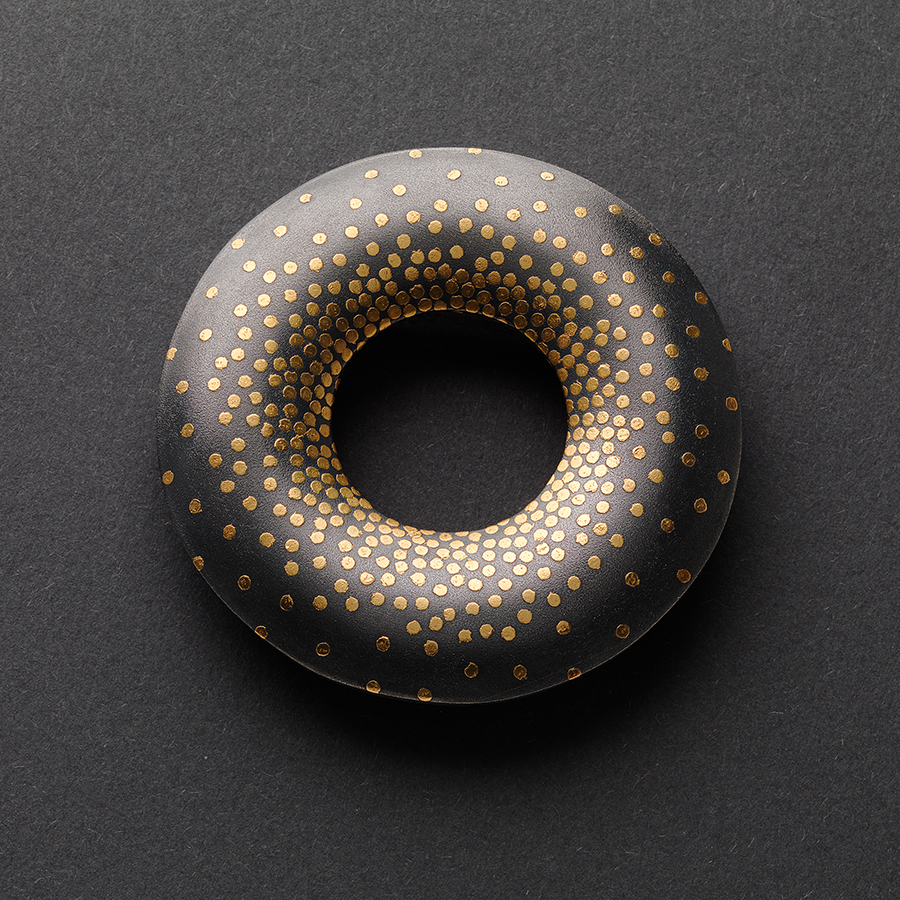
Contemplating the Afterlife
Through my practice, I have considered the role of the afterlife in our earthly existence. I am interested in people’s relationships with death and how we deal with the one certain thing that will happen to us all. My visual inspiration began with a jade ring-shaped object called Bi. Bi is an ancient Chinese artefact often used as a burial object to assist the deceased in their journey to the afterlife.
For myself, the ideology of an afterlife is routed in time. Lives, how many of them are unknown, pivot around time. The cyclic nature of the torus in my collection represents the cycle of death and rebirth that all material things undergo. Each torus has its own individual story told through intricate patterns and textures, each its own version of the afterlife. I use the act of meticulously creating each detail repeatedly as a meditation that brings a timelessness to the making process, mirroring the ongoing journey of an afterlife.
Materiali: Oxidised Sterling Silver, 999 Gold. Hand-made granulation.


HANKUNYU WEI

Fantasy or Conjecture
"Fantasy and Conjecture" is about a feeling, an imagination and curiosity about unfamiliar spaces and worlds. It's a feeling that exists between people and spaces or objects, or even between people themselves. It's like the curiosity and fear behind a locked door, or the desire for a locked box.
This collection focuses on the development and innovation based on the key itself. I collected old keys and used them as raw materials, cutting and welding them to transform their original functions. All the key rings are linked together to form a necklace. The modified keys are affixed to steel plates and sandblasted to preserve their shapes on the surface. Each part is connected using rivets, allowing for a 360-degree rotation without the key rings.


GIULIA CALZARETTI

WORDLESS THOUGHT
Starting from the light and space movement, whose presence is both abstract and concretely real, I transformed a commonly known material, hot glue, to reflect and shape my own interpretation of what light and space could look like. I believe any form of artistic work should allow the viewer to observe its own knowledge and approach being shaped. The path I chose is based on “presences” in space, which are meant to be interpreted in the light passing through the piece.
In my experimentation, I shifted my vision towards this ordinary material and its applications to achieve a transformation that is not connected to any context or place but instead focuses on the individual perception of a few elements, such as light and space. The message I want to convey is wordless: to make oneself aware of one's emotions without being constructed into a specific message to follow.
Materials: Hot glue-silver leaf.


DARIO MEL

160 MILLION BC
Today, as young designer, I believe that it is more important than ever to take into consideration the materials we use.
I decided to work with leaves, something natural that is meant to decompose. I explored them in all possible ways until I discovered that by putting ink on them, their veins created a pattern that reminded me of reptile skin.
In this way, I see my material as an alternative to crocodile leather.
Sadly, everyday crocodiles are being hunted down and killed for their skin to then create leather goods for the fashion market. At least seven different crocodile species are currently listed as critically endangered. My mission is to create something new, something that doesn’t enquire the mass killing and extinction of a spectacular species that has been around since more then 160 million years. I don’t want to be a part of that. I dedicate this project to all the wildlife that remains.
Materials: Magnolia grandiflora leaves, silver.


